![Main.png]](https://knowledge-hub.greyparrot.ai/hs-fs/hubfs/Main.png?height=40&name=Main.png)
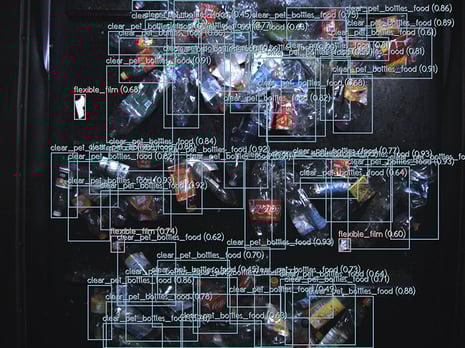
How does AI distinguish between food and non-food grade material?
Our cameras see the same way humans do: in RGB.Consumer products are designed to be recognised and differentiated by humans – that’s why it’s easy for us to distinguish between a milk bottle and a detergent bottle even though they’re both made of HDPE plastic.
Our model behaves like a consumer. It identifies the features (shape, colour, caps, etc.) that make a product distinctive, and uses experience to determine whether or not it’s a food product.
Can you recognise overlapping items?
Yes! Our AI recognises overlapping items, as long as they’re still partially visible. The rule of thumb is “what a human can see, the AI can see”.We might need to update that rule – our AI often outperforms manual sorters when it comes to recognising overlapped objects! In some cases, we can detect objects that are underneath transparent items. A fully covered object won’t be detected, though.
Can you recognise waste items from different countries?
Yes. We’ve already deployed units outside the UK and EU, from South Korea to India, Peru and Egypt. We continuously build the data from these markets into our models.
Many objects – like plastic bottles – share basic characteristics around the world, too. Our AI is able to accurately infer product and material types based on common features.
We don’t just rely on those similarities. The onboarding process gives us a chance to tailor our model according to its use case. It ensures that we’re adapting our AI to the requirements of each waste stream – and market.
Can you distinguish between different polymers? Is that even possible without NIR sensors?
We can’t currently distinguish between polymers directly, but we are able to infer polymer types based on the visual features that make a product recognisable to the human eye.
By assessing shape and colour, we can infer an item’s purpose. Once we know that, it’s fairly easy to determine the polymer used. Soft drink bottles are mostly made of PET plastic, for example. Milk bottles tend to be HDPE, as do detergent bottles. Since those items don’t look at all similar, we’re able to categorise by product and likely polymer.
This allows us to produce data that current NIR based optical sorters can’t access. Black plastic, food- vs. non-food grade materials and multi-layered packaging (e.g PET bottles covered with LDPE sleeves) confuse NIR systems.
Do you plan to integrate other sensors, like NIR?
Yes! We’re currently working on adding NIR sensors to our monitoring unit, and aim to release the new hardware in Q1 2023.
Once added, they’ll allow us to differentiate between polymers in more detail and with more certainty. Combined with our current AI-powered computer vision, we’ll be able to accurately recogmise 120+ materials based on shape, colour, polymer type and function.
Can you detect batteries?
Batteries are already in our taxonomy, and we are currently working on improving our ability to recognise them.We can detect batteries as long as they are visible, and our performance will increase as we gather more data (images) of them in the waste stream. Plant operators can set up alerts so they’re notified as soon as a battery is detected.
Can you sort between dark-coloured plastics?
We currently classify dark brown plastics as “coloured PET”, and black plastic as “black plastic”. We are currently working on separating black plastic into :Black_containers; black_flexible_film and other_black_plastic (anything else).
We're also working on going further by splitting our “coloured PET” class into sub-classes (green PET, brown PET, etc.), and by integrating NIR sensor to recognise each polymer types.
Can you work with C&D facilities?
We are currently working in the C&D industry with two projects: one in a C&D sorting plant (8-60mm and 30-300 lines) and one in a recycling centre producing cement, component and recycled aggregates and scrap metal from demolition waste.
Because of the diverse nature of the waste – wood, PVC pipes, metal parts, concrete blocks, insulation, cables of different shapes, colours and sizes – we are confident our recognition system will perform very well.
Can you identify which plastics have Brominated Fire Retardants (BFR)?
We can't detect BRF directly, as it's not a visual characteristic. With that said, we can detect WEEE, which are some of the main plastic products that include this compound.