![Main.png]](https://knowledge-hub.greyparrot.ai/hs-fs/hubfs/Main.png?height=40&name=Main.png)
💡 Learn how to add these new material types to your scenarios here 👉here
💡 View our updated material recognition library 👉 here
We’ve added 26 new material types to our recognition library, expanding our AI’s ability to recognise plastic and glass packaging in granular detail.
What’s new?
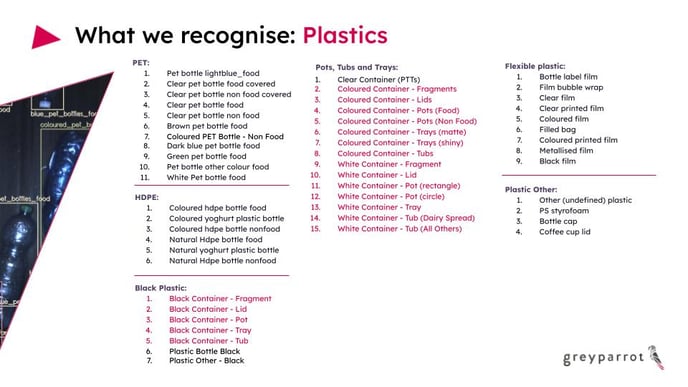
The new and renamed material types are shown in red below:
.jpg?width=688&height=387&name=Taxonomy%20slides%20updated%20-%20March%202024(1).jpg)
The update expands four of our existing material types to provide even more detailed waste stream analysis. The additions include some of the most common and valuable recyclable objects found on dry mixed recycling streams :
- Container Black (PTTs) ->
- Container Black (PTTs) - Fragment
- Container Black (PTTs) - Lid
- Container Black (PTTs) - Pot
- Container Black (PTTs) - Tray
- Container Black (PTTs) - Tub
- Container Coloured (PTTs) ->
- Container Coloured (PTTs) - Fragment
- Container Coloured (PTTs) - Lid
- Container Coloured (PTTs) - Pot Food
- Container Coloured (PTTs) - Pot Non Food
- Container Coloured (PTTs) - Tray Matte
- Container Coloured (PTTs) - Tray Shiny
- Container Coloured (PTTs) - Tub
- Container White (PTTs) ->
- Container White (PTTs) - Fragment
- Container White (PTTs) - Lid
- Container White (PTTs) - Pot Circle
- Container White (PTTs) - Pot Rectangle
- Container White (PTTs) - Tray
- Container White (PTTs) - Tub Other
- Container White (PTTs) - Tub Spread
- Glass ->
- Glass - Bottle Brown
- Glass - Bottle Clear
- Glass - Bottle Green
- Glass - Cullet Brown
- Glass - Cullet Clear
- Glass - Cullet Green
- Glass - Other
How the expansion improves plant performance monitoring
More detailed recognition means more actionable insight. With this most recent expansion, you’re able to:
- Get more granular insight into product line purity and contamination 🔍
- Analyse (and act on) smaller variations in infeed composition 📊
- Track material mass even more accurately (e.g. glass bottles vs glass cullets) ⚖️
- Track sorting performance, targeting new classes of pots, tubs, trays and bottles 📈
- Understand your container breakdown in more detail than ever 🔬
In some cases, you’ll even be able to infer an object’s polymer type based on the container type. An object identified as ‘Container White (PTTs) - Tub Spread’, for example, will most often be made of polypropylene 🥤


☎️ We’re here to help! Book a call with our customer success team, and we’ll configure your settings together 👉 Get in touch